

At Earth’s apex: a marathon to the Geographic North Pole
As a child growing up in Burrabazar, Kolkata, I lived with my family in a humble two-room home with an asbestos roof built on a terrace. We shared a common bathroom with other families, and every evening I would stand on our terrace watching aeroplanes disappear into the sky. As they flew away, I would wave and say, “Aeroplane bye-bye.”
Back then, I never imagined that one day I would sit inside those aeroplanes, travel across the world, or stand at the very top of our planet.
Life has an extraordinary way of rewarding impossible dreams
On 5 July 2025, after flying from Oslo, I landed in Longyearbyen, on the island of Spitsbergen in Norway’s remote Svalbard Archipelago. It was nearly 2:00 a.m., yet the sun shone brightly. Experiencing the magical Midnight Sun for the first time was surreal. Snow-covered mountains, colourful wooden houses, icy fjords and absolute silence surrounded me. Time itself seemed to stand still.
Longyearbyen felt like the edge of civilisation. Beyond Svalbard lay only drifting sea ice, towering glaciers, polar bears and the vast Arctic Ocean stretching all the way to the Geographic North Pole.
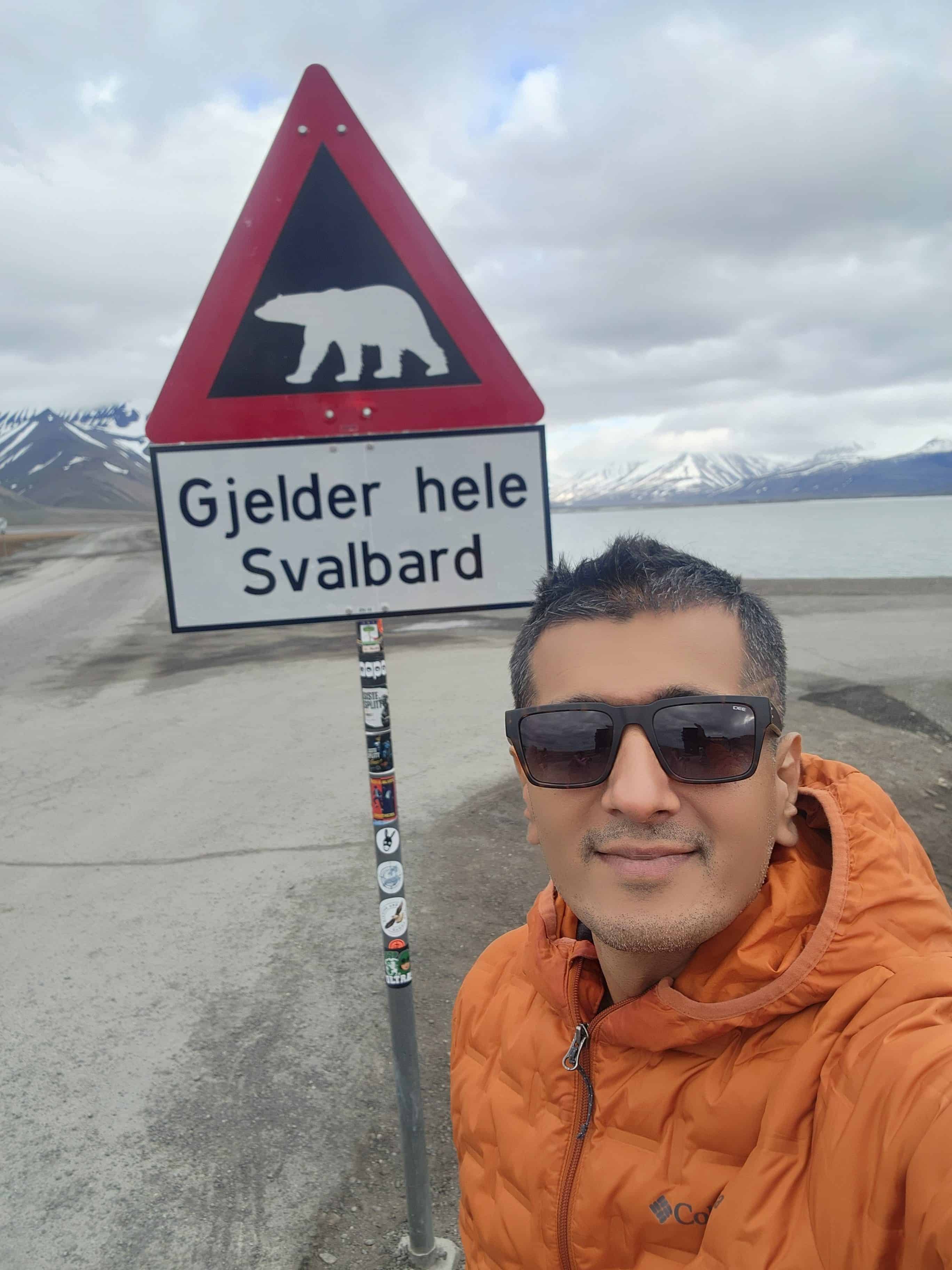
The next two days were spent exploring this magical Arctic town. I completed my final marathon practice run beneath the never-setting sun and visited Svalbard’s famous Polar Bear warning sign, reminding every visitor that outside the settlement, humans are no longer at the top of the food chain.
Standing beside that sign, I smiled for a photograph
Little did I know that within days I would witness 15 wild polar bears, sail across the frozen Arctic Ocean and become the first Indian to complete a full marathon at the Geographic North Pole (90° North).
Into the Frozen Arctic
On 7 July, I boarded Le Commandant Charcot, Ponant’s magnificent luxury icebreaker specially designed to conquer the frozen Arctic Ocean. As the ship slowly departed Longyearbyen, excitement filled the air. Every passenger knew we were about to experience something very few people on Earth ever would.
Nature welcomed us with breathtaking beauty
The Arctic sky transformed into shades of gold, orange, pink and violet, creating a rainbow-like glow across the endless horizon. It was impossible to tell where the sea ended, and the sky began. The silence of the Arctic was so profound that even the sound of the waves felt gentle.
Then came our first unforgettable wildlife encounter
The captain announced, “Whale whale!” A magnificent blue whale surfaced beside our ship, gracefully gliding through the icy waters before disappearing into the deep blue ocean. Watching the largest animal ever to live on Earth in its natural habitat left everyone speechless.
The following morning, another blue whale appeared, almost as if the Arctic itself was welcoming us. That evening, after the Captain’s Welcome Party, we suddenly felt a deep vibration beneath our feet. The entire ship trembled.
Everyone rushed outside
The mighty Le Commandant Charcot had reached the frozen Arctic Ocean.
For the first time, I watched an icebreaker smash through thick Arctic sea ice. Massive slabs cracked apart with thunder-like sounds as the powerful ship carved a path through the frozen ocean. Standing on deck, watching centuries-old sea ice breaking apart beneath us, was both humbling and mesmerising.
From that moment onwards, open water gradually disappeared. There was only endless white stretching to the horizon.
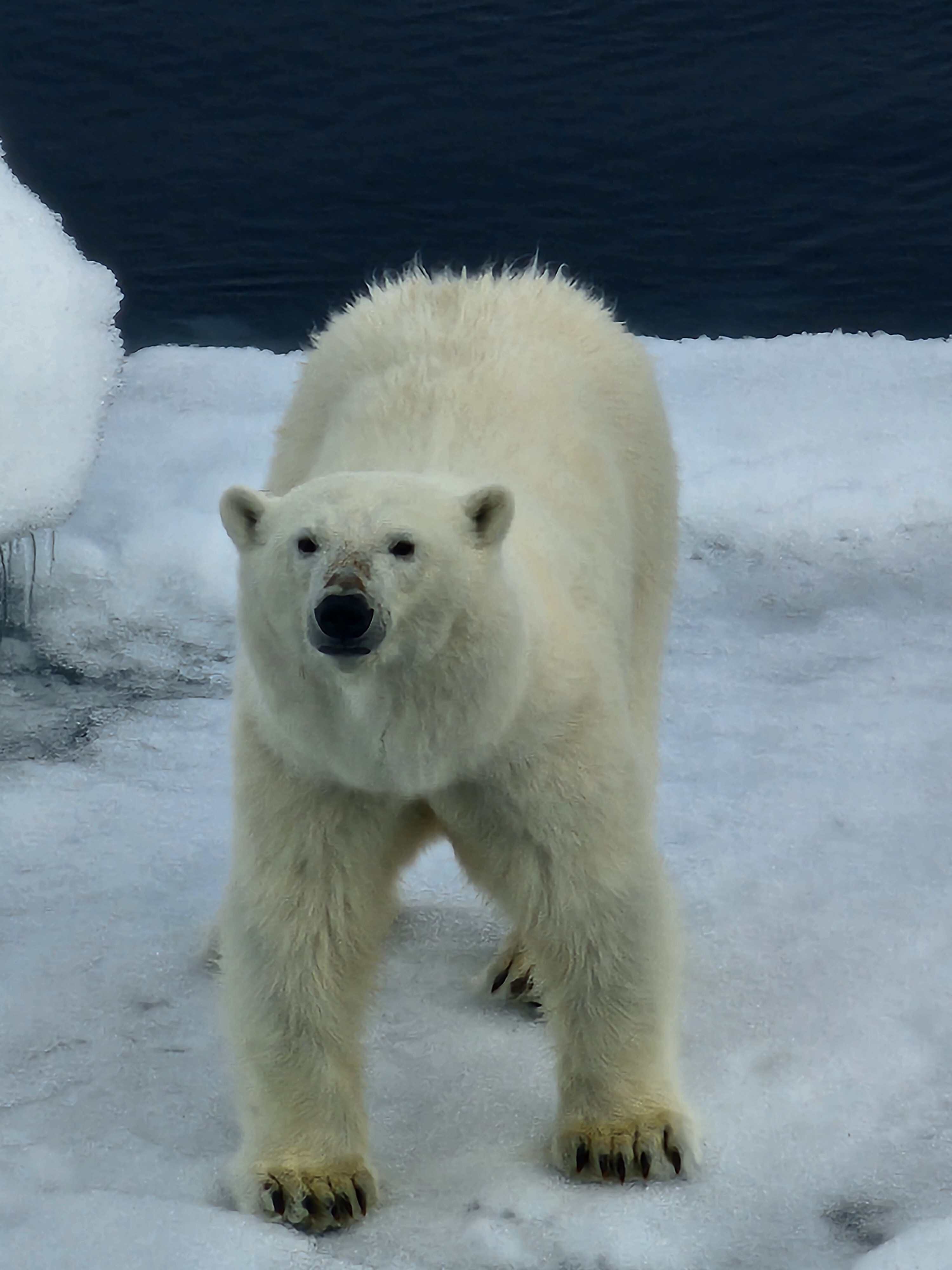
Within minutes came another unforgettable announcement. “Polar Bears!” There they were. Two magnificent polar bears walking gracefully across the drifting sea ice.
The excitement onboard was unbelievable. Cameras clicked continuously as passengers gathered on every deck. Seeing the king of the Arctic roaming freely in its natural kingdom was a moment I will never forget.
The Kingdom of the Polar Bear
The Arctic rewarded us with unforgettable surprises every single day. At around 3:00 a.m., the captain announced another polar bear sighting. Passengers rushed out of their cabins, many forgetting jackets in their excitement despite temperatures below freezing.
Standing remarkably close to our ship was another magnificent polar bear. One encounter became particularly memorable when a polar bear stood upright on its hind legs for several seconds, curiously observing our ship. The expedition team told us that witnessing such behaviour in the wild was exceptionally rare.
During our expedition, we encountered 15 polar bears, nine while travelling north and six while returning south.
Every sighting felt magical
We watched Arctic seals resting peacefully on floating ice, thousands of seabirds soaring overhead and an Arctic fox running effortlessly across the frozen landscape.
One of the most unforgettable moments came when we saw the carcass of a dead whale lying on the sea ice with a huge polar bear feeding beside it. It was a powerful reminder that this frozen wilderness follows its own timeless rhythm, untouched by human civilisation.
Another fascinating experience was meeting a team of French Arctic scientists conducting research on the frozen Arctic Ocean. Listening to their stories about living and working in one of the harshest environments on Earth made us appreciate the fragile beauty of the Arctic even more.
With every passing hour, Le Commandant Charcot continued breaking through thicker and thicker ice. The thunderous sound of cracking ice became the soundtrack of our expedition as we sailed ever closer to 90° North.
The Top of the World
Finally, on 12 July 2025, the announcement everyone had been waiting for echoed throughout the ship.
“Captain announced 90.00° North Pole”, then the ship erupted into celebration. Music played, champagne flowed, fireworks lit the Arctic sky, people danced, hugged and celebrated with tears of joy.
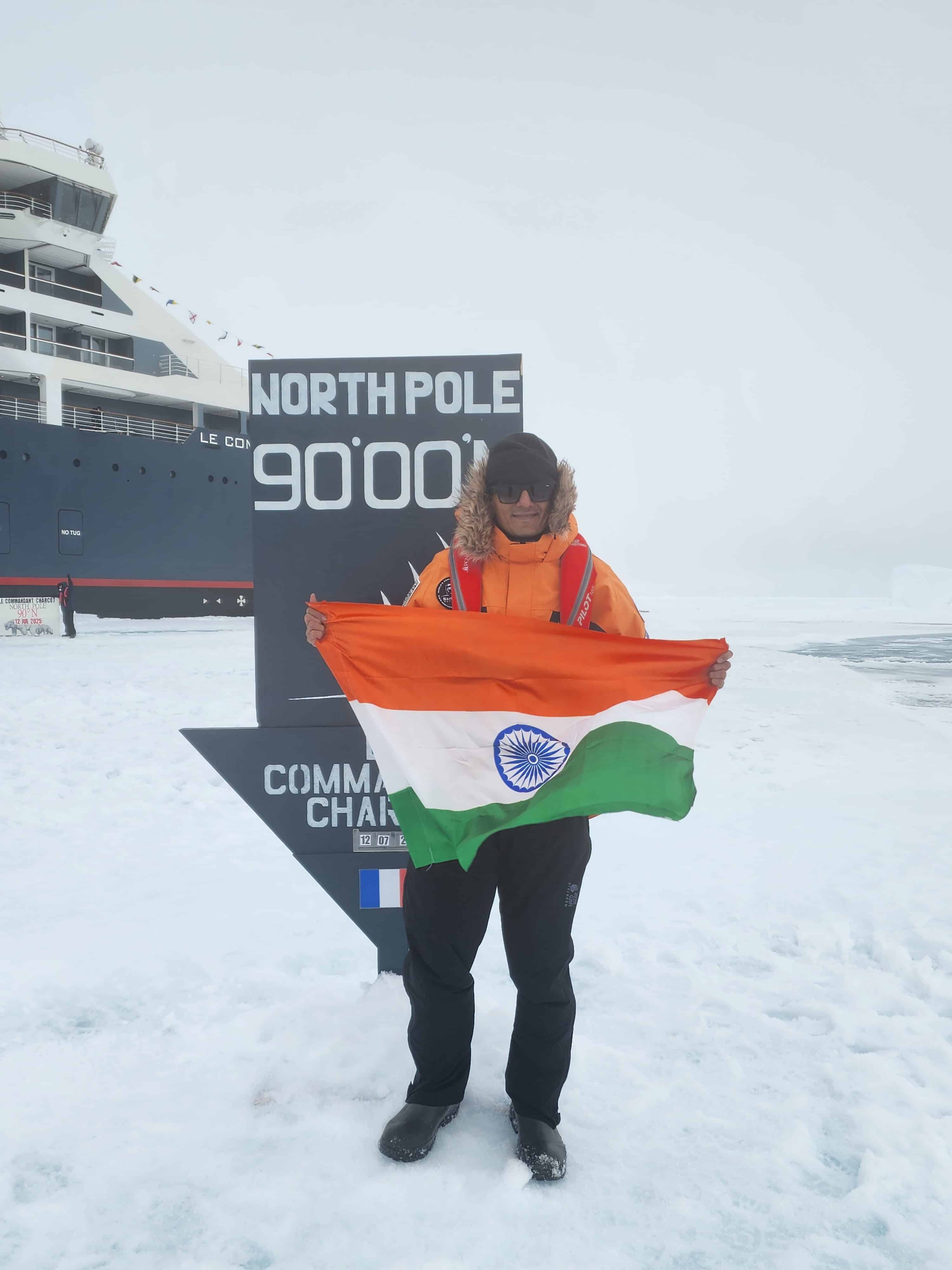
We had reached the Geographic North Pole—the exact top of our planet. Stepping onto the drifting Arctic sea ice at 90° North remains one of the greatest moments of my life. There was no land beneath my feet, only the floating Arctic Ocean thousands of metres deep. Every direction from where I stood was south.
Holding the Indian Tricolour at the top of the world filled me with indescribable pride. Yet my greatest challenge still lay ahead. Marathon at 90° North. On 13 July 2025, at around 8:45 a.m., the North Pole Marathon began.
The temperature was around –8°C, while powerful Arctic winds made it feel even colder. Wearing only my base layer beneath a Gore-Tex jacket, pants, and Trail Run Shoes, I immediately felt my hands and nose beginning to freeze.
The first half of the race was covered with snow and hard-packed ice. Then, after approximately 26 kilometres, the sun emerged. Everything changed. The frozen course rapidly transformed into slush and freezing pools of water. My running shoes filled with icy water, making every step heavier than the last.
The final 16 kilometres became the toughest part of my life. My legs repeatedly sank deep into the melting snow. Every step required enormous effort just to pull my feet back out. There were moments when it became difficult even to walk. Freezing water soaked my shoes while exhaustion and repeated cramps tested every ounce of determination I possessed.
But giving up was never an option. I had travelled halfway around the world for this moment. Hour after hour, one step at a time, I kept moving forward. Finally, I crossed the finish line. On 13 July 2025, I became the first Indian to complete a full marathon at the Geographic North Pole (90° North), run entirely on the floating ice of the frozen Arctic Ocean. Years of dreaming had become reality.
A Journey Beyond Dreams
Our return journey was equally unforgettable. A planned kayaking expedition had to be cancelled after a polar bear was spotted swimming towards our landing site, while another landing reminded us of the Arctic’s unpredictability when a passenger accidentally broke through the sea ice before being safely rescued.
Exploring the Svalbard Archipelago by Zodiac, we encountered towering glaciers, dramatic mountains, millions of nesting seabirds, colourful Arctic flowers, grazing reindeer and untouched tundra that looked like something from another world.
Eventually, we returned to Longyearbyen. The expedition cost approximately €44,900, excluding international flights. Many would call it expensive. For me, it was priceless.
Because the true value of a journey is never measured by what it costs it is measured by the memories it creates and the dreams it fulfils.
Whenever I look back, I don’t just remember the blue whales, the 15 polar bears, the endless sea ice or the marathon at the top of the world.
I remember the little boy standing on an asbestos roof in Kolkata, waving at aeroplanes. He never imagined that one day those aeroplanes would carry him from an asbestos roof… to the Roof of the World.
Read More: Explore the World