

New Business Travel Show America research reveals a growing gap between AI integration expectations and technology reality, as wider technology satisfaction across the sector is regarded as average
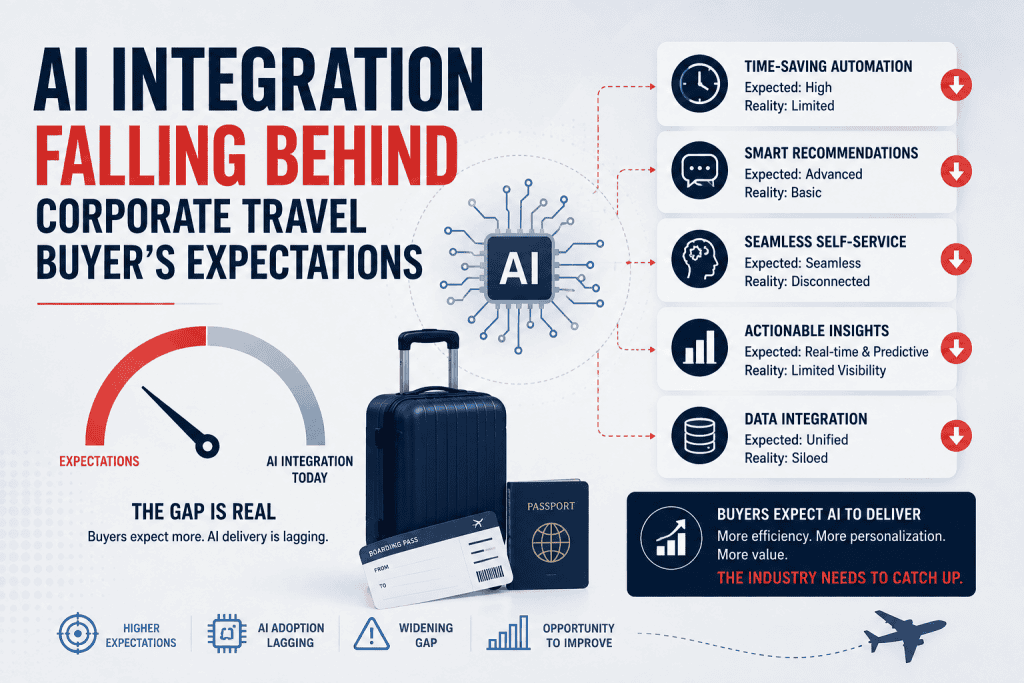
There is a growing disconnect between AI ambition and application within the corporate travel sector with one in five buyers (21%) citing slow AI integration as a key tech pain point.
Despite this frustration, AI is also expected to have the greatest influence on corporate travel over the next 15 months, taking over the lead from global economic pressures and inflation, which took the top spot in last year’s survey.
This is according to new research from Business Travel Show America of more than 200 corporate travel decision-makers based in North and South America.
The top five factors buyers expect to have the biggest impact on business travel in the next 15 months, compared to last year’s survey are:
| 2026 | 2025 | |
| AI | 22% | 19% |
| Advances in technology and data | 17% | 15% |
| Global economic pressures and inflation | 16% | 26% |
| Dynamic pricing and rate negotiations | 16% | 8% |
| Geopolitical tensions and conflict | 11% | 13% |
Customization and flexibility emerging as major barriers
In addition to AI integration issues, the top three biggest tech frustrations facing buyers all focus on customization (buyers were asked to choose up to three options):
- Updates and customization taking too long (44%)
- Lack of customization options (41%)
- Additional costs for customization (37%)
- Poor integration between tools (31%)
- Insufficient access to data (26%)
Commenting on the findings, Tenise McCoy, Global Travel & Security Manager, Paysafe, said: “AI will absolutely be a major force in the future of business travel, but we still need to see more practical applications. We aren’t just looking for more technology or more tools. What we really need is greater flexibility from our existing tools and the ability for them to communicate with one another, improve reporting, simplify administration and support better decision-making. The findings reflect both the excitement surrounding AI and the frustration we’re feeling with its lingering limitations.”
Technology satisfaction remains average
This may explain why just 7% of respondents are happy with their current tech stack, giving it a 5/5 rating. Almost half (49%) scored three out of five, and just under 14% rated it at one or two.
When asked what single change they want to make to their tech stack, comments from the 200+ respondents repeatedly referenced a need for greater flexibility, stronger reporting capabilities, improved online booking tools, easier system administration and more seamless integration between travel, expense and payment platforms. Several respondents also called for more opportunities to pilot and test AI capabilities before wider deployment, highlighting a desire for practical implementation rather than theoretical discussion.
Katherine Vaillancourt, Director, Indirect Procurement, Samuel, Son & Co., Limited added: “To maintain a competitive advantage, travel programs must integrate AI quickly without sacrificing accuracy. Ambition will drive adoption, but as our analytics evolve, having robust, reliable data will be the true differentiator between simply deploying AI and driving measurable value.”
Finding out more at Business Travel Show America
The findings indicate the future of business travel technology will be shaped not only by the emergence of AI but by how effectively it is integrated into flexible, connected and user-friendly platforms that provide corporate travel buyers with the intelligence and control needed to manage increasingly complex travel programs.
Read More: News