

One vivid journey through sacred music, daily ritual and the best temples to visit in South India
Before sunrise, South India has already begun to pray. Bells move through the blue hour as camphor smoke gathers above oil lamps. Jasmine scents the cool air. Garlands arrive fresh, chants begin softly and temple doors open onto rituals repeated across generations.
This journey crosses five states, each with its own language, architecture and way of approaching the divine. Guruvayur in Kerala gathers around Lord Guruvayurappan before daylight. Tirumala in Andhra Pradesh rises to the repeated name of Govinda. Hampi in Karnataka keeps the love of Goddess Pampa and Lord Virupaksha alive beside the Tungabhadra. Warangal and nearby Ramappa in Telangana bring prayer, sculpture and dance together. Madurai in Tamil Nadu awakens under the gaze of Goddess Meenakshi.
These are living places of worship, understood through practice as much as architecture. Devotees carry offerings, wait for darshan and recognise every flower, chant and shared pause as part of the pilgrimage.
For travellers planning a South India temple tour, these five destinations offer distinct encounters with faith. One begins in darkness, another climbs a sacred hill, one survives among imperial ruins, another finds rhythm in stone and dance, and the last places a warrior goddess at the centre of an entire city.
Guruvayur: Lamps Before Daylight
In Guruvayur, the day belongs to Lord Krishna before it belongs to anyone else.
Worship begins in the dark, when the Kerala air is still cool and the glow of oil lamps remains brighter than the approaching dawn. Lord Krishna is worshipped here as Lord Guruvayurappan, a divine presence held close through daily prayer, family vows and visits repeated across a lifetime.
Temple tradition connects the deity with Dwaraka. Guru, the divine preceptor Brihaspati, and Vayu, the wind god, are believed to have carried the sacred image south to Kerala. Their names came together in Guruvayur. The legend gives the deity a journey of his own: Lord Krishna travels, finds a home and becomes inseparable from the spiritual life of the town.
The temple’s emotional reach also comes through poetry. During the 16th century, Melpathur Narayana Bhattathiri composed the Sanskrit Narayaneeyam in praise of Lord Guruvayurappan. Poonthanam expressed his devotion in Malayalam, the language heard in local homes. Different in style, both poets made the deity feel close to the listener.
Music continues that intimacy. Sopana sangeetham, Kerala’s traditional temple singing, is performed near the steps leading towards the sanctum. Accompanied by the small, hourglass-shaped idakka drum, it remains measured and contemplative, gently guiding attention towards the ritual.
A precise cycle of pujas unfolds before sunrise. During abhishekam, the ceremonial bathing of the deity, Lord Guruvayurappan is bathed, dressed and decorated with flowers and ornaments. Lamps are prepared, offerings are arranged and each act readies the sanctum for darshan.
When the doors open, devotees see Lord Guruvayurappan and receive his divine gaze. The glimpse is brief, but its meaning has gathered through music, incense and waiting. Families often return after marriages, births, recoveries or fulfilled prayers, turning a visit into inherited memory.
Guruvayur also asks travellers to enter on the temple’s terms. Dress requirements are observed, footwear and phones are left outside designated areas, and entry rules should be checked before arrival. The experience is most rewarding when the schedule remains light. Arrive early, allow time for the queue and pay attention to the lamps, recitations and small gestures around you. Guruvayur’s power lies in discipline softened by affection.
Tirumala: The Hill of a Million Longings
One name travels constantly through the Seshachalam Hills: Govinda.
It rises along Alipiri Mettu and Srivari Mettu, the traditional walking routes followed by devotees climbing towards Tirumala. Some repeat the name quietly, matching it to their breath. Others call it aloud and allow the chant to pass through the crowd. With every step, the climb becomes part of the prayer.
Tirumala is accessible by road, yet walking carries special meaning for many pilgrims. Families climb together, older devotees set a determined pace and volunteers offer encouragement. The ascent tests the body while giving the mind one clear destination.
Many devotees offer their hair through tonsure before entering the temple. The ritual expresses saranagati, or complete surrender to Lord Venkateswara. Vanity is placed aside and the pilgrim approaches without ornament. It may fulfil a vow made during difficulty or express gratitude after a prayer is answered.
Lord Venkateswara is worshipped as a form of Lord Vishnu present for Kali Yuga, the age in which humanity now lives. This belief gives the relationship its emotional force. The deity is understood as spiritually close and attentive to every prayer. The hopes carried up the hill are addressed to someone believed to hear them.
The music of Annamacharya shapes that bond. The 15th-century Telugu saint-composer created thousands of songs praising Lord Venkateswara. Moving through philosophy, humour, romance and surrender, they carried the deity’s name beyond the shrine and into homes, concerts and daily worship.
Modern Tirumala operates on an extraordinary scale. Online bookings, timed entry, accommodation systems and organised queues help manage immense numbers of pilgrims. The practical structure is essential, although the older rhythm remains beneath it. Govinda’s name still travels through waiting halls and along the final approach.
As darshan nears, conversation falls away and attention turns towards one point. Lord Venkateswara appears amid gold, flowers, incense and light. After the climb, the planning and the long anticipation, the moment arrives with startling clarity. The famous Tirupati laddu received afterwards carries the experience home as prasad.
Book only through authorised channels, confirm the current darshan rules and avoid building a tight onward schedule. Tirumala rarely rewards impatience. Its central lesson is carried in the climb and the queue: surrender includes giving up control over time.
Hampi: Where the Ruins Still Pray
In Hampi, worship begins beside the Tungabhadra River.
Goddess Pampa, revered as a local form of Goddess Parvati, is closely associated with this landscape. Tradition says that she entered deep penance, holding herself in focused prayer as she sought union with Lord Shiva. Here, Shiva is worshipped as Lord Virupaksha.
The story gives Hampi its spiritual centre. Goddess Pampa does not wait passively for grace. She prays with patience and purpose. Her devotion is answered, and her marriage to Lord Virupaksha becomes the defining sacred story of the place. The name Hampi itself is linked with Pampa through changes in local pronunciation across time.
Hampi later became the magnificent capital of the Vijayanagara Empire. Today, its boulder-filled landscape holds temple complexes, market streets, gateways, water structures and royal remains. Yet Virupaksha Temple is more than a survivor among ruins. Worship has continued there, linking the living town with the sacred and imperial histories surrounding it.
That continuity changes how the ruins are experienced. Hampi is often photographed for its stone chariot, carved halls and dramatic terrain, yet the active temple places ritual first. Lamps are lit, bells ring and devotees carry coconuts and flowers through the entrance. Heritage and faith occupy the same ground.
Each year, ceremonies, processions, percussion and devotional singing celebrate the marriage of Virupaksha and Pampa. Their union leaves the sanctum and enters public life, renewing the relationship between temple and town.
Begin beside the river at first light, then walk through the bazaar axis towards Virupaksha Temple and continue to Hemakuta Hill. The distances and heat can be deceptive, so divide the sacred and royal areas across separate outings when time permits.
Hampi rewards slower attention. A carved pillar, worn threshold or active shrine may reveal more than a hurried circuit. Its spiritual mood is strongest when the site remains a landscape, not a checklist.
Near sunset, the rocks hold the day’s warmth and the Tungabhadra reflects a softer sky. Hampi then feels suspended between several times: Pampa’s mythic devotion, Vijayanagara’s grandeur and the prayers continuing now. Its power rests in that coexistence.
Warangal and Ramappa: When Devotion Begins to Move
Warangal’s sacred landscape carries the confidence of the Kakatiya period, when architecture, sculpture and performance formed a connected cultural world.
At the Thousand Pillar Temple in Hanamkonda, Lord Shiva, Lord Vishnu and Lord Surya are worshipped in three shrines. The arrangement creates several spiritual paths within one complex. Shiva draws the mind towards inner stillness, Vishnu carries the assurance of protection and Surya brings the clarity and vitality of light.
Built under Kakatiya ruler Rudra Deva in the 12th century, the temple has a star-shaped plan, carved pillars and a large monolithic Nandi. Observe how the pillars shape light and movement; the stone creates rhythm before music begins.
Maha Shivaratri gives the temple its deepest night of worship. Devotees fast, offer bilva leaves and remain awake as chants continue into the early hours. Time is measured through successive pujas. The vigil turns wakefulness into devotion.
The journey continues to Ramappa Temple at Palampet. Dedicated to Shiva as Rudreshwara, it stands near a Kakatiya reservoir amid fields and wooded hills. Water, cultivated land, architecture and worship form connected parts of its sacred environment.
Construction began in 1213. Sandstone, carved granite and dolerite display Kakatiya artistry, while lightweight porous bricks reduce the tower’s load. Polished bracket figures appear almost metallic as dancers, musicians, animals and mythic forms animate the surface.
Look closely at the dancers. Their bent knees, extended arms and poised torsos make still stone appear ready to move. The sculptures record regional performance traditions and help explain why dance belongs so naturally within the story of the temple.
Perini Shivatandavam gives this energy a living body. Associated with devotion to Shiva, the Telangana tradition draws strength through grounded footwork and insistent percussion. Its force connects with tandava, Shiva’s cosmic dance. Each step lands like an offering.
Allow a full day for Warangal and Ramappa rather than treating them as quick architectural stops. Morning light is well suited to the Thousand Pillar Temple, while Ramappa deserves time for its carvings and wider landscape. Together they show devotion expressed through geometry, engineering and movement.
Madurai: A Goddess Holds the City
Madurai does not merely worship Goddess Meenakshi. The city moves according to her presence.
She is queen, warrior and divine ruler. Her legend begins with her birth after a royal ritual seeking a child. Meenakshi appeared with three breasts and a prophecy that the third would disappear when she met her divine consort. She grew into a warrior, led campaigns and ruled with authority before encountering Lord Shiva.
When they met, the prophecy was fulfilled. Shiva came to Madurai as Lord Sundareswarar, the Lord of Beauty, and became her consort. The spiritual power of the story lies in the place Meenakshi continues to hold. Sundareswarar enters her world, while her sovereignty remains complete. Their marriage expresses companionship without diminishing her identity.
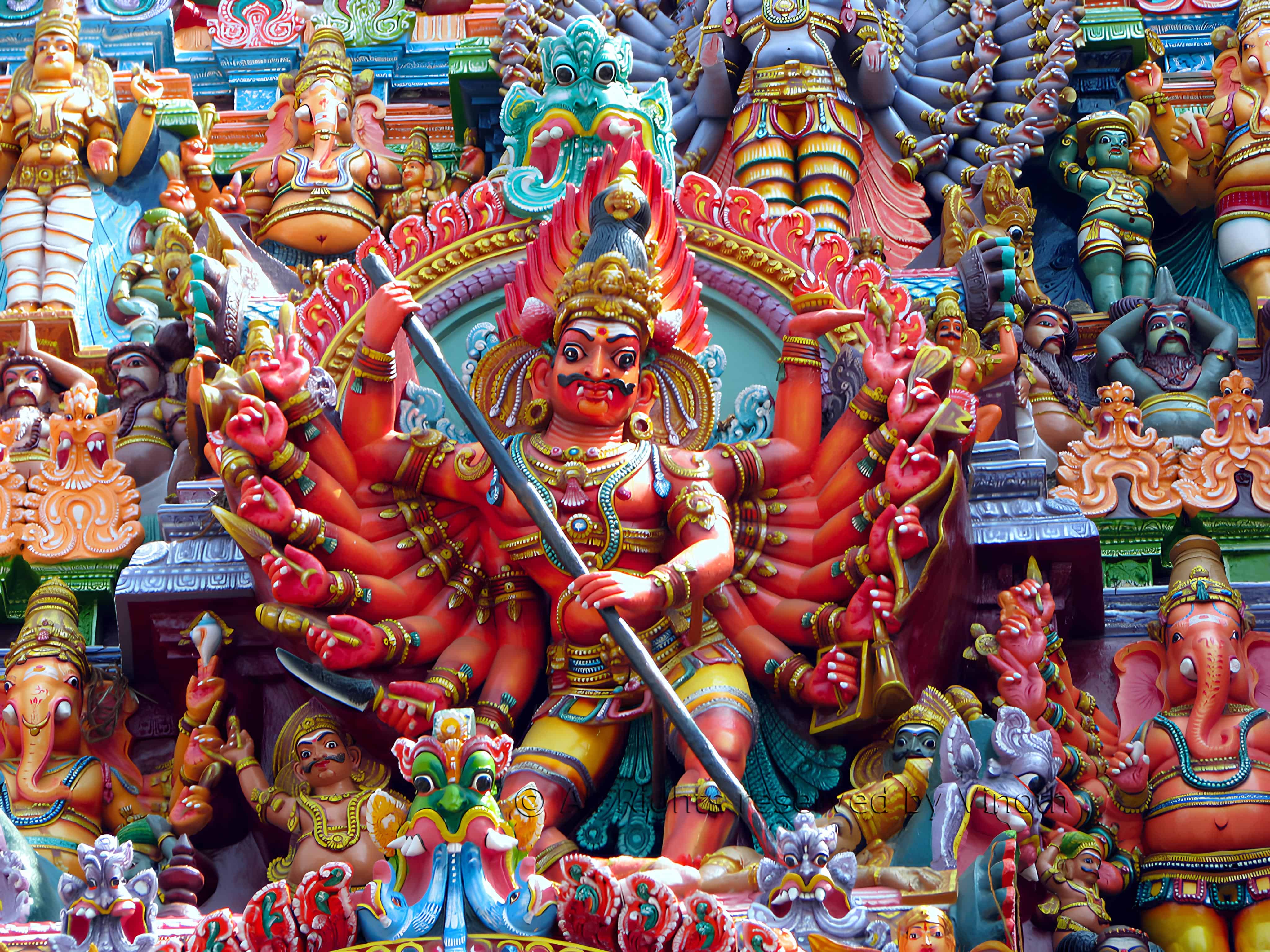
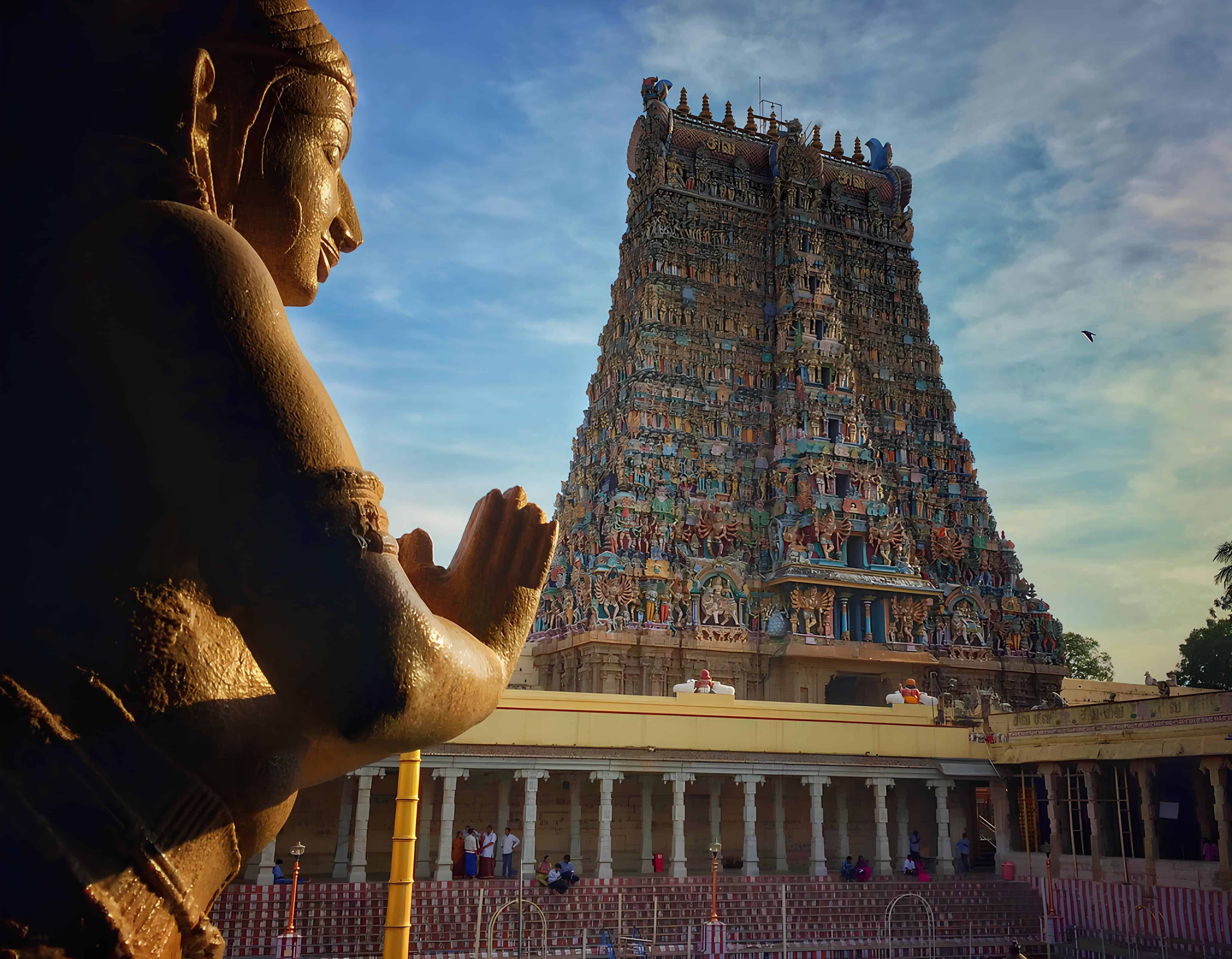
The temple occupies the heart of Madurai, surrounded by streets that follow its geometry. Its gateway towers rise above shops selling flowers, brass lamps, textiles and offerings. Inside, corridors, painted ceilings, sculpted columns, tanks and shrines create a world that cannot be absorbed in one glance. Colour appears at every scale, from towering figures on the gopurams to a line of fresh kumkum placed before a small shrine.
During the Chithirai festival, Meenakshi’s story takes over the city. She is crowned, her victories are honoured and her marriage to Sundareswarar is celebrated through elaborate ceremonies and processions. The sequence places her authority at the centre before the wedding begins. Devotees become participants in a divine event renewed each year.
Their relationship also returns nightly through the Palliarai ceremony. The word refers to the bedchamber. During the ritual, Sundareswarar is taken in procession towards Meenakshi’s chamber. The grand annual wedding becomes an intimate daily expression of companionship.
The nadaswaram, a long double-reed wind instrument, and the thavil, a barrel-shaped drum, give temple ceremonies their unmistakable Tamil sound. Music moves ahead of the procession, filling the corridors with dignity and energy. It tells waiting devotees that the divine household is in motion.
Visit once during the day to appreciate the architecture and return in the evening for the ceremonial atmosphere. Dress respectfully, expect security checks and confirm current photography rules at the entrance. Leave time for the streets around the temple, where jasmine sellers, tailors, metalworkers and food stalls extend its energy into daily life.
In Madurai, worship carries the confidence of a reigning goddess. The ceremonies return to her, the music announces her and the city remains unmistakably hers.
Planning Your South India Temple Tour
These destinations span a large region. Link Guruvayur with Kochi, Tirumala with Tirupati, Hampi with Hospet, Warangal with Hyderabad, and Madurai independently.
Temple rules can change during festivals and peak pilgrimage periods. Check official guidance for entry, clothing, tickets, restricted items and opening hours shortly before travelling. Carry light clothing that covers shoulders and knees, keep footwear easy to remove and use a small bag. Some temples restrict phones or photography within important areas.
The cooler months generally make long walks and queues more comfortable, although major festivals offer extraordinary atmosphere with much larger crowds. Early mornings reveal the devotional rhythm most clearly. Evenings are ideal for processions, music and lamps. A balanced itinerary includes both.
Most importantly, allow space for delay. Temple travel follows ritual schedules, security arrangements and the movement of pilgrims. The unplanned pause often becomes part of the experience.
FAQs
What are the five spiritual destinations covered in this journey?
The route includes Guruvayur in Kerala, Tirumala in Andhra Pradesh, Hampi in Karnataka, Warangal with nearby Ramappa in Telangana, and Madurai in Tamil Nadu. Each section focuses on a distinct combination of deity, ritual, music, architecture and local tradition.
How many days are needed for this South India temple journey?
Allow at least ten to fourteen days if you want to visit all five regions without rushing. Extra time is useful for Tirumala’s darshan arrangements, Hampi’s extensive landscape and the road journey between Warangal and Ramappa. The route can also be divided into shorter state-based trips.
What should travellers remember before entering these temples?
Wear respectful clothing and check official entry rules before arrival. Carry minimal belongings, follow instructions concerning phones and photography, and avoid obstructing active worship. Quiet observation is often the best way to understand a ceremony. Festival visitors should book transport and accommodation early while keeping daily plans flexible.
Five Places, Five Languages of Faith
Across these five stops on a South India temple tour, worship changes its form without losing its emotional centre. Guruvayur gathers devotion in lamps and poetry. Tirumala turns a climb and a queue into surrender. Hampi allows prayer to continue amid an imperial landscape. Warangal and Ramappa hold rhythm within stone, while Madurai places a goddess at the centre of civic life. These temples provide the setting, while music, offerings, waiting and prasad reveal people who keep their sacred rhythms alive each day.
Read More: Discover Your India