

Shwetank Singh, Managing Director and Chief Executive Officer of Chalet Hotels, in an exclusive interview, speaks with Kamal Gill, Executive Editor, Today’s Traveller, on steering the company into its next phase of growth
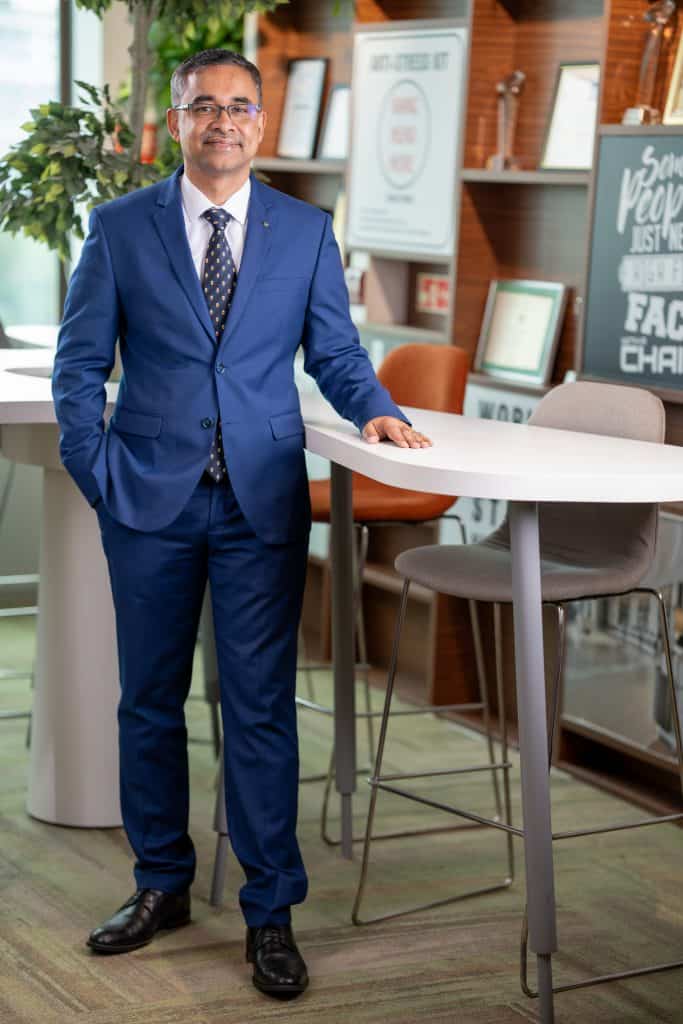
With 25 years of experience spanning hospitality, real estate, strategy management and business operations, Shwetank Singh brings a track record shaped by portfolio performance, growth planning and asset-led decision-making across globally recognised organisations.
Stepping into what he describes as a “textbook succession”, he is clear that Chalet is not a turnaround story, but an “opportunity job” built on strong assets in high-barrier markets, a well-funded balance sheet and clean governance. His leadership lens focuses on moving the company “from good to great”, with scale as the next discipline to master. The shift, he says, is in the “software” of the organisation: decentralised decision-making, greater transparency, and a culture that gives teams the confidence to act, learn and move
TT BUREAU: You’ve stepped into the role at a moment when Chalet appears well-positioned. What did you see when you took over, and how are you approaching this mandate?
Shwetank Singh: I think I’ve been fortunate to inherit a company that’s already in very good shape. If you look at Chalet today, we sit on strong assets in strong markets, and those markets have very high barriers to entry. We have a well-funded balance sheet. Our reputation is clean, and we are a compliant company, so debt availability is strong as well. The headroom we have to grow is, in that sense, very good.
When I look at my own journey into this role, it was almost a textbook succession. Everything was put in place properly. The board was well informed. The previous incumbent was well informed. Every step was structured and handed over in the right way.
I also want to clarify what I mean by “lucky”. I mean it in a very practical, unromantic way. The company’s fundamentals were strong, governance was in place, and the platform was clean. So I didn’t walk into a repair job; I walked into an opportunity job. That changes your mindset.
TT BUREAU: How do you see Chalet fitting into the group’s premiumisation direction, and where do synergies become a real lever?
Shwetank Singh: We are indeed fortunate to have promoters who are ambitious. They see Chalet as a real growth engine. And if you look at the group’s play right now, the K Raheja Corp. is premiumising across the board. If you want to premiumise any real estate asset, then the “totalisation” of that asset becomes central to the outcome. In my mind, that’s the play. If we can leverage group synergies working properly, then as a group, we will be in very strong shape.
And Chalet, as I said, is in great shape on all those fronts. We have now put in place a senior leadership team, and I genuinely think we are poised to take advantage of the opportunity.
On the group side, premiumising is not a slogan. It’s a visible pattern across businesses. Chalet fits that direction, and hospitality, and the totalisation of assets, support the group’s premium positioning. That is why I keep coming back to synergies: not as a buzzword, but as a lever.
TT BUREAU: As Chalet moves into a faster growth phase, what are the biggest shifts you’re trying to drive internally to manage scale and keep the organisation future-ready?
Shwetank Singh: My approach has been simple. I only needed to see that we were a good company, and I wanted to make it great. So, our journey is good to great. And as we move from good to great, one more thing becomes critical: we need to learn to manage scale. We weren’t small, but we also didn’t have the explosive growth we are now aiming for. Managing scale and growth is not easy. It requires a fundamentally different way of thinking.
So, in my mind, it’s the “soft” thinking, the software, that needs to change. One of the biggest shifts I’ve pushed is decentralised decision-making. And on decentralisation, I’m not romanticising it. It’s hard. It means leaders let go, teams step up, and a few decisions will be wrong. But the alternative is worse: every small decision rolls up, and senior leaders spend their days in noise.
I tell my leadership team: the more decisions that roll up to you, the less time you have to think forward, and that is unacceptable. If we can work six hours a day instead of eight, I will be happiest. And you’ll laugh at this, but I tell them: if the samosa arrives in the office at four o’clock, that means we are in good shape. And the samosa line is half humour, half a metric: if you don’t have time to breathe, you don’t have time to think forward, and then scale becomes far harder to manage for anyone.
That’s why this is important to me. We have to keep pushing decision-making down the line so that more strategic thinking can happen. We have more levers to play with. Earlier, it was mainly execution. Now we have assets to execute, an asset management practice running, a brand coming into play, and hotels that we operate for others. We now have almost all levers at play. And we can’t use those levers if we are dousing fires every day. So that shift, if we can make it, will be the single biggest contribution I make as a leader.
To enable that, I’m very passionate about people and culture. It’s easy to say you want decision-making lower down, but no leader will do it if they don’t feel confident in their own skin. And for people to feel confident in their skin, you have to provide what I call a “safer” environment. There is no truly safe environment today, so I call it safer.
How do you create that? In my mind, you do it through transparency. Transparency is one of the central cultural pillars I’m pushing into the organisation, and it starts with how we behave. A simple example: I come back from a board meeting, and I do a five-minute town hall for the whole organisation to tell the teams what happened. I realised people are anxious, they want to know what happened, what was discussed, and what the strategy is. So I share openly.
If we fully understand where the real story is happening, then we support it, we enable it, and we create a transparent senior leadership environment where people can say, “It’s okay, it’s my fault, I’m there,” and they also feel there is a larger organisation behind them.
TT BUREAU: You’ve spoken about creating a safer culture while still staying anchored in accountability. How do you build that balance, and what changes have you made to performance and recognition systems?
Shwetank Singh: We’ve democratised our appraisal system. We made KRAs totally measurable. People agreed to them and signed off on them. So in our appraisal conversations, we don’t debate “what happened” because what happened is in the number. We only discuss the “how”. When we discuss the how, there is a rating process.
There is a committee that sits and talks through every promotion. I’m not part of that committee. They discuss every promotion, every highest rating, and every low rating. They decide as a committee. They come to me only for sign-off. I am not in it. There is a grid linked to the appraisal system, and people get appraised according to the grid. Some people may need correction; that’s the reality of the world. Critical roles may need long-term incentive plans, absolutely fine.
I know organisations that will quietly promote people, and nobody talks about it. I’ve made it aspirational. Today it’s you, tomorrow it will be someone else. Be happy for your teammates. We bring people in front of the office, and we say, “Eight people have been promoted.” We clap for them, and they throw us a party.
TT BUREAU: How do you read the industry’s current run, and what are the biggest risks you see if the sector loses discipline?
Shwetank Singh: I think the industry, as we have seen over the last five years, has had a fantastic run. But what we also tend to forget is that between 2008 and 2019, the industry went into a slumber. What we did achieve in that period was that a plethora of brands entered India. And the Indian customer was being steadily educated towards taking shorter holidays, taking multiple holidays, taking driving holidays, and not staying with friends and family. That broad education between 2008 and 2019, accelerated by COVID, is what is playing out now in customer behaviour. So yes, this run has been fantastic.
The fundamentals behind this run haven’t really changed. And generally, what trips up an industry like ours is either the larger economy, because other sectors start to suffer and people have less money to spend, etc., which, for now, seems to be in a reasonably good place overall.
The other classic trait the industry shows is supply. Suddenly, there’s a herd mentality. One market starts doing well, and everybody wants to rush in. Hyderabad is a classic case in point today. Hyderabad is doing well; it’s on fire. The people already there are making money right now, but that can change very rapidly. Every market goes through cycles. Big supply comes in, performance suffers, and then it picks up again. The good thing is that India’s growth rate is so robust that, despite all the supply being announced, there is still scope.
The second thing we need to fully comprehend as an industry is that it’s difficult to build a hotel in India. So even if 100 hotels are announced today, not everything will actually come into play. If you look at the last four to five months, there’s a consensus among investors that supply is coming out of our ears, because everybody is making massive announcements. It feels like a déjà vu of 2007–08, when everyone wanted to do a minimum of 70–80 hotels. That wave of announcement is coming through again.
But what’s changed is that back then, there weren’t enough listed players. Now the landscape is different. So the investor is suddenly looking at it and saying: The revenue cycle is slowing down and the capital cycle is coming in. That mismatch is something no industry likes.
But if you look at the overall market, we believe that there is still scope for growth on the business side. On the leisure side, yes, we will go through a little bit of a slowing in demand, and it won’t necessarily show up in occupancy. I think what we’re feeling is some rate pressure, because we’re now pushing the envelope at the higher end of the spectrum. And these guests are well-travelled. They have the world at their feet. Thankfully, our hotels are better: better built, better kept, better managed, and our hospitality is warmer. And from that perspective, my belief is that the aspirational class is growing.
Overall, I believe the industry is in a good place if we overlay it with a realistic view of supply.
TT BUREAU: Athiva is being watched closely. Why did Chalet choose to launch a brand now, and how are you thinking about its scope, partnerships, and long-term build?
Shwetank Singh: Let’s talk about Athiva Hotels & Resorts in a broader context to begin with. As a company, we have been sort of pioneers in how we saw this industry. And why I call ourselves pioneers is because we were the ones who first took up the challenge of building big boxes. And doing big boxes at a time when the unit economics were not understood was, I think, a brilliant move and hats off to our promoters for taking that call at that time.
Whether it was Powai with 777 rooms, Sahar, later with 588 rooms, or Bangalore with 520 rooms. Between the two Westins in Hyderabad, we are almost pushing 470-500 rooms there. And to take those big box calls at a time when nobody was taking them was a brilliant move in my mind.
Then, in 2009, we made another move very quietly. We entered the franchise space through Four Points by Sheraton. And that experimentation is currently playing out. Today, if you see our portfolio, we are now becoming very serious in the franchise space. The Taj (Delhi International Airport) that is opening with us will be the first franchise that IHCL has ever given. And that’s a testament to the fact that the industry believes in Chalet.
And with Hyatt Regency Airoli, Navi Mumbai, being planned and a couple of other hotels that we are operating, we are now becoming a serious player in the franchise space. That, in my min,d is only the second step. The third step would be how to develop property capability. And then the last question on that continuum would have been, do we need our own brand?
And I think the above property piece started in the form of an asset management team, which has always been very strong for us. If you see our margins, our cost control, etc., it has been absolutely top of the line. All our metrics are at the top of the heap of the industry. In fact, I can proudly say that most of the industry wants to follow our case. So, I think kudos again to the team who brought this to this point and their line of thinking at that point in time.
So we used that base to start to develop our property capability on the marketing side, sales side, revenue side, etc. And the brand launch at this stage is, in my mind, the natural progression. Right now, once again, we hunker down. We will take the risk on our properties. We will prove to ourselves and to the customers that we can do and will deliver this promise, day in and day out. Only then will we be in a position to go to the owner and say look we have done this.
Very interestingly, if you see, we have taken a very different path from others. Who said that once our brand is launched, all our properties will be the same? We have just announced a Ritz-Carlton. We want to do this because we know that having the power of distribution of a Marriott or a Hilton is a plus. We are not kidding ourselves. They have been at it for 150 years. We will need time. So, our brand experiment in my mind is an experiment for the next generation.
But in the meantime, we will understand it. We will fully comprehend it. We may take help on the soft brand side with some of the big brands. So that our distribution doesn’t suffer. But we will build our own distribution over time, and the best way to do it is to start from the domestic market.
And therefore, we have chosen a name which is very Indian. We wanted to look Indian. We wanted to feel Indian, and that’s where the genesis comes from, a Sanskrit word. Athiva is based on the pillars of joy, wellness and sustainability.
But what we are trying to say is that we are today dealing with both types of customers. We are still dealing with the guests who enter the hotel and think that they should have a bevvy of people around them. Catering to all their needs. And we are also dealing with the guest, who is no nonsense, who doesn’t want to be bothered with our services.
So that’s why we call it the assurance of the expected and the joy of the unexpected. So that’s our core. We know that we want to have only two versions. One is for the city, and one is for the resort. One will be called Athiva Resort and Spa. The other one will be called Athiva Hotels, and that’s it. We are going to stick to that.
I think as we go along, we will work on the pillars of joy very closely. Because we think genuinely that that is a differentiator. We want to properly develop our wellness play also. As society becomes more aspirational, wellness is becoming more important. Wellness was important when the Rishi Munis were there in ancient India, and now it’s come a full circle. I think it’s a natural progression: you move into luxury, and then you go back to the basics. That’s what’s happening right now. So yes, wellness will become bigger, and we will want to be in this space.
The important thing for us here is to understand that we are starting on this journey, and the learning has been absolutely immense.
Our learning curve is so steep right now. Take Athiva Resort and Spa, Khandala – the first advantage of the place is where it is positioned and located. I think it is one of the most scenic spots in that valley. You can see seven waterfalls from the room. So, it is actually quite stunning.
The experience at Athiva Resort and Spa, Khandala, has been extremely well-received. So clearly, we have hit something. I can tell you that the idea of joy driving wellness is certainly new. And I don’t think we have fully played it out. Today, the wellness arena goes from absolutely hospital-like, totally curated, very regimented on the one hand, to putting in three rooms of the spa and calling it wellness on the other. But there is nobody who’s provided the joy spin on wellness, and we will certainly capitalise on this.
Read more – Today’s Traveller Interviews