

From royal kitchens to temple traditions, India’s vegetarian thalis serve luxury with culture, colour and soul.
A vegetarian thali is India’s most elegant argument for abundance. It arrives not as one dish, but as a complete mood: radiant, fragrant, precise, generous and deeply regional. In its circular form, it carries the confidence of a cuisine that has never needed minimalism to look sophisticated. A spoonful of golden dal, a curl of crisp papad, a lick of pickle, a mound of fragrant rice, a sweet placed at the edge for later or perhaps for right now. Everything has a place, and everything has a purpose.
The thali is often described as a meal, but that feels too plain for something so layered. It is hospitality made visible. It is also memory, geography, ritual and appetite arranged in metal, leaf, brass, kansa or silver. Across India, it reflects not only what communities eat, but how they welcome, celebrate, worship and impress. A thali can be rustic, royal, temple-pure, merchant-refined or gleefully theatrical. The charm lies in its range.
There is also a modern reason why the thali feels luxurious again. In an age of tasting menus and curated dining experiences, the thali offers something sharper: a complete culinary landscape without fuss. No awkward decisions, no performative ordering, no fear of missing the signature dish. The kitchen makes its case in one sweep. The guest simply arrives hungry and leaves with a sense of having travelled.
The Palace Hotel Revival of the Thali
India’s palace hotels and luxury resorts have given the vegetarian thali a glamorous second life. What once belonged to family dining rooms, festive kitchens and traditional eating houses now appears under chandeliers, in marble courtyards, beside lily ponds, near carved jharokhas and under canopies lit by flickering diyas. The mood is old-world without feeling trapped in nostalgia. A gleaming thali, handled with care, can be as dramatic as a vintage silver service trolley.
At these properties, presentation carries almost as much meaning as taste. Attendants in traditional attire move with quiet precision, placing katoris around the main grain, filling the platter in a rhythm that feels practised and personal. Brass glows under soft lighting. Kansa ware adds earthy elegance. Silver trays bring a courtly shimmer. Textiles, table flowers, sandalwood notes and heritage crockery become part of the scene.
The recipes do the heavy lifting. Palace thalis often draw on royal khanas, temple kitchens and community traditions, bringing together dal baati churma, Gujarati valor muthiya, fragrant kadhi, seasonal greens, millet breads, spiced buttermilk, house-made pickles and desserts with old-family confidence. Some hotels add thoughtful modern accents: artisanal ghee, smoked chutneys, or a lassi poured like a sommelier’s proud flourish.
This is where the thali becomes more than a plate. It places guests inside a deeper story of region, memory and ceremony. Every bite hints at a court, a caravan, a temple bell, a monsoon crop, a desert pantry or a grandmother’s guarded recipe. Done well, the palace thali does not feel heavy with grandeur. It feels beautifully hosted.
The Ceremony of Serving
A thali begins before the first bite. The ceremony of service is its own kind of theatre, refined without being stiff. A server approaches with warm rotis. Another follows with dal, then vegetables, then chutneys and sweets. The sequence matters. Katoris of silken dal, spiced kadhi and jewel-toned sabzis encircle rice, khichdi, millet or bread. Papads crackle into position. Chutneys shimmer in tiny portions. Pickles sit at the rim like small, fiery warnings.
There is a graceful intelligence to the arrangement. Sweet, sour, salty, bitter, crisp, soft, cooling, warming, dry and sauced all find balance. A bite of dal and rice softens pickle heat. A piece of baati pulls in ghee and lentils. A spoon of kadhi brightens a dry sabzi. Papad adds snap where the plate grows mellow. Dessert waits patiently, though not always successfully.
In heritage settings, banana leaves may unfurl as green platters, carrying a faint earthy perfume. In luxury dining rooms, hammered brass bowls and silver salvers make the ritual gleam. At temple-style meals, the rhythm becomes gentler, almost meditative. A rosewater hand rinse may begin the experience. A bell, a smile, a second helping offered before the guest asks: these small details carry the thali’s heart.
The best thali service is never pushy, yet it is wonderfully persuasive. It understands that generosity in India is rarely silent. Refills arrive with warmth. “A little more?” is not a question as much as a cultural instinct. The table loosens. People compare favourites, surrender to second helpings, laugh over spice levels and quietly abandon the idea of eating lightly. Luxury, here, is the pleasure of being looked after.
Bahubali Thali: Spectacle on a Plate
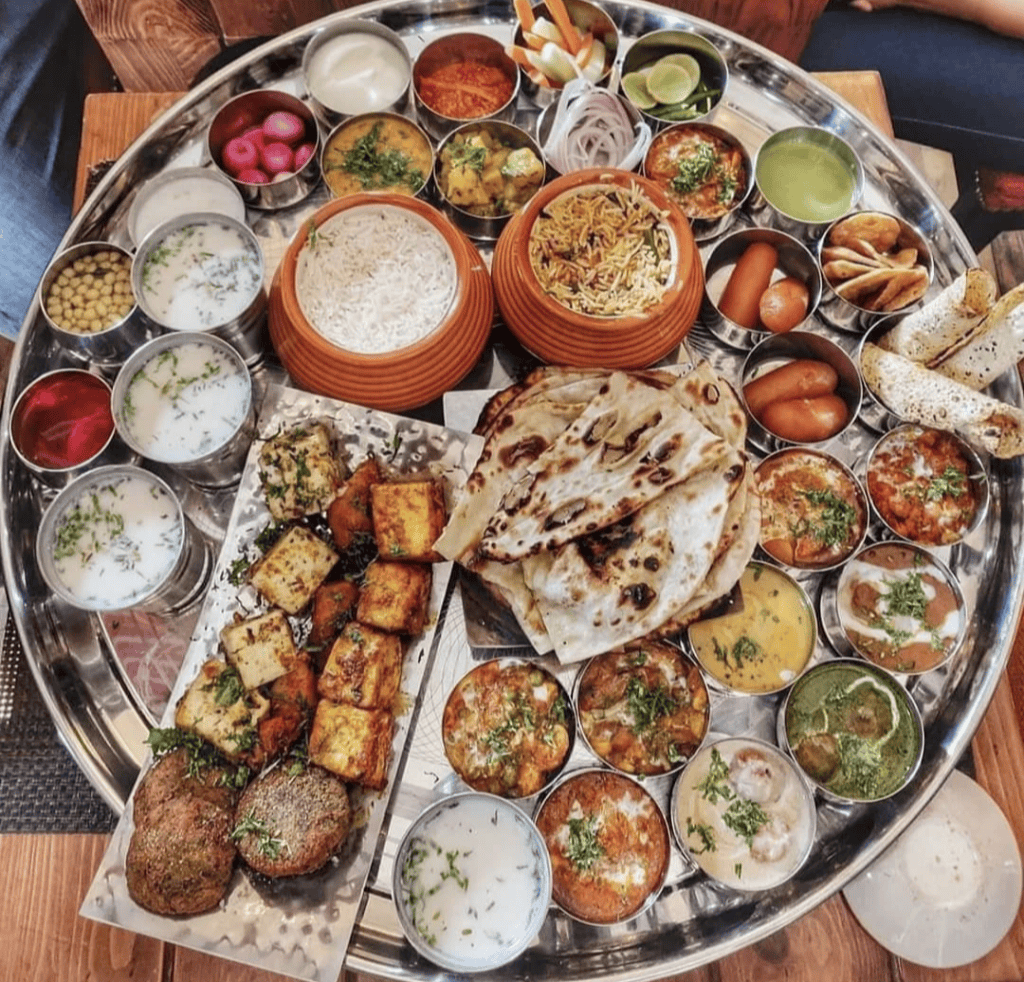
The Bahubali Thali is the blockbuster of vegetarian dining. It does not enter quietly. It arrives like a cinematic reveal, usually on a vast steel platter loaded with a thrilling number of dishes, often ranging between 30 and 54. It is oversized, overjoyed and completely unembarrassed by its own drama. In an era built for food photographs, this thali understands the assignment better than most.
Its appeal lies in scale, but also in the childlike delight of abundance. Katoris brim with dal makhani, paneer gravies, chole, kadhi, raita, chaat, vegetables, pulao, chutneys and sweets. Breads stack up in buttery folds. Jalebis curl in golden spirals. A tower of papad may appear with the confidence of architecture. Somewhere on the plate, a bright pickle or sharp chutney cuts through the richness and keeps the excess lively.
The Bahubali Thali belongs to modern India’s appetite for celebration. It borrows its spirit from community feasts, wedding spreads and old-school hospitality, then scales it up for the social dining age. It is usually meant for sharing, often feeding four to six people, which makes it less of a meal and more of a group event. People lean in, phones come out, servers smile knowingly, and the first few minutes are spent simply understanding the geography of the platter.
Its roots may not be as ancient as temple thalis or regional royal spreads, but its instinct is completely Indian. Food is used to mark joy, welcome and occasion. Across cities such as Ahmedabad, Hyderabad and Delhi, this larger-than-life platter has become a symbol of edible theatre, where size, colour and variety do the talking. In heritage-style restaurants and high-energy dining spaces, a Baahubali thali turns lunch or dinner into a full social occasion. Its luxury lies in largesse, and it serves abundance with a grin.
Rajasthani Royal Thali: Desert Opulence
The Rajasthani Royal Thali carries the romance of the desert, but not in the pale, postcard way. This is a thali of strong flavours, clever preservation, ghee-rich comfort and regal memory. It proves that landscapes of scarcity can produce cuisines of astonishing depth. In Rajasthan, the pantry learned early how to work with dry ingredients, hardy grains, pulses, sun-dried vegetables, wild berries, spices and dairy. The result feels both practical and opulent.
At the centre often sits dal baati churma, Rajasthan’s grand edible signature. Wholewheat baatis, baked or roasted until smoky and firm, are cracked open and flooded with ghee. Panchmel dal, made with five lentils, brings depth and spice. Churma adds a sweet, crumbly finish, golden and fragrant, often enriched with dry fruits. The trio has the balance of a royal composition: earthy, rich, sweet, savoury and deeply satisfying.
Around it, the thali builds its desert orchestra. Gatte ki sabzi brings gram flour dumplings in a tangy yoghurt gravy. Ker sangri combines wild berries and beans in a sharp, spiced preparation that tastes of the land itself. There may be bajra roti, missi roti, garlic chutney, mangodi, kadhi, boondi raita, pickles and sweets such as ghevar, motichoor laddoo, malpua or badam halwa.
What makes this thali luxurious is not only the richness of ghee or the glow of brass. It is the craft behind every survival ingredient turned into celebration. Dried beans become delicacies. Gram flour becomes dumplings, snacks and gravies. Millets gain dignity under skilled hands. Spices carry heat, perfume and memory. From Jodhpur’s sandstone glow to Udaipur’s lake-facing elegance, the Rajasthani royal thali belongs to spaces that understand drama.
Gujarati Kathiawadi Thali: Bold and Bountiful
The Gujarati Kathiawadi Thali is sunshine with attitude. It is lively, generous, rhythmic and wonderfully alert to contrast. Sweetness meets heat. Buttermilk cools chilli. Farsan adds crunch. Kadhi soothes. Pickles bite back. The plate keeps changing character as the meal moves along, and that is exactly its charm.
Kathiawad, in Gujarat’s Saurashtra region, brings a bolder, more rustic accent to the larger Gujarati thali tradition. Millet breads, garlic chutneys, spicy vegetables and earthy pulses sit comfortably beside delicate snacks and sweets. There may be bajra rotla, theplas fragrant with fenugreek, sev tameta, ringan no oro, lasaniya batata, undhiyu in season, khichdi, kadhi, toor dal, lilva kachori, khandvi, dhokla, sev khamani and crisp papad.
Then come the accompaniments, which are never minor in a Gujarati thali. Chutneys, pickles, fried chillies, jaggery, salad, raita and chaas act like a clever supporting cast. A spoon of sweet dal softens the spice. A sip of buttermilk resets the palate. A bite of farsan brings crunch back into play. Basundi, shrikhand, mohanthal or jalebi may close the meal, though in a traditional thali the sweet often arrives early, because Gujarat does not believe pleasure should wait.
Service is central to the experience. Refills arrive in rhythmic, almost musical rounds. Servers move clockwise, offering one dish after another with cheerful insistence. There is no preciousness here, yet in luxury dining rooms the same format can become unexpectedly elegant. Silver and kansa platters give the meal a warm glow. Fine linens, heritage interiors and careful plating bring polish without flattening the thali’s personality.
In Ahmedabad, celebrated Gujarati thali restaurants have turned this abundance into an institution. In Dwarka and other heritage-rich settings, the meal carries the flavour of pilgrimage, trade, coastline and community life. The Kathiawadi thali is not shy. It has spice, sweetness, crunch, comfort and a fierce sense of welcome. Its luxury lies in energy. It feeds not only the appetite, but the table’s mood.
Marwari Thali: Refined Merchant Heritage on a Plate
The Marwari Thali is Rajasthan’s more restrained, merchant-polished cousin, though restrained is a relative word when ghee, sweets and fried delicacies are involved. Rooted in the traditions of Marwari trading communities, it reflects mobility, thrift, inventiveness and a deep understanding of pantry intelligence. Ingredients with long shelf life, such as besan, dried legumes, millets, papad, sev and pickles, are turned into dishes of remarkable comfort and finesse.
A Marwari thali may carry dal baati churma, but its personality often reveals itself through details: papad ki sabzi, mangodi, panchkuti sabzi, ker sangri, gatte, kadhi, missi roti, bajra roti, mirchi vada, papad kachori, bhujia sev, moong dal halwa, boondi laddoo and ghevar. The flavours are layered rather than loud. Spice brings warmth. Ghee brings sheen. Dry textures are balanced with yoghurt gravies, dal and kadhi. Crunch is never far away.
There is refinement in the way pantry staples are elevated. Besan becomes dumplings, fritters and crisp snacks. Papad moves beyond accompaniment into gravy. Sun-dried ingredients return to life with masala and patience. Millets, once valued for resilience, now feel chic in a world rediscovering ancient grains. The Marwari thali quietly proves that luxury does not always begin with rare ingredients. It may begin with skill, memory and restraint in the right places.
The merchant history behind the cuisine adds another layer. Marwari communities carried their food habits across trade routes, adapting without losing identity. Their vegetarian traditions travelled with them, finding homes in havelis, business households, festive gatherings and community feasts. In Shekhawati havelis, Jodhpur hotels and fine-dining spaces inspired by palace life, the Marwari thali feels especially at ease. It has the grace of a family heirloom, polished often, never over-explained.
Satvik Temple-Style Thalis: Sacred Simplicity as Luxury
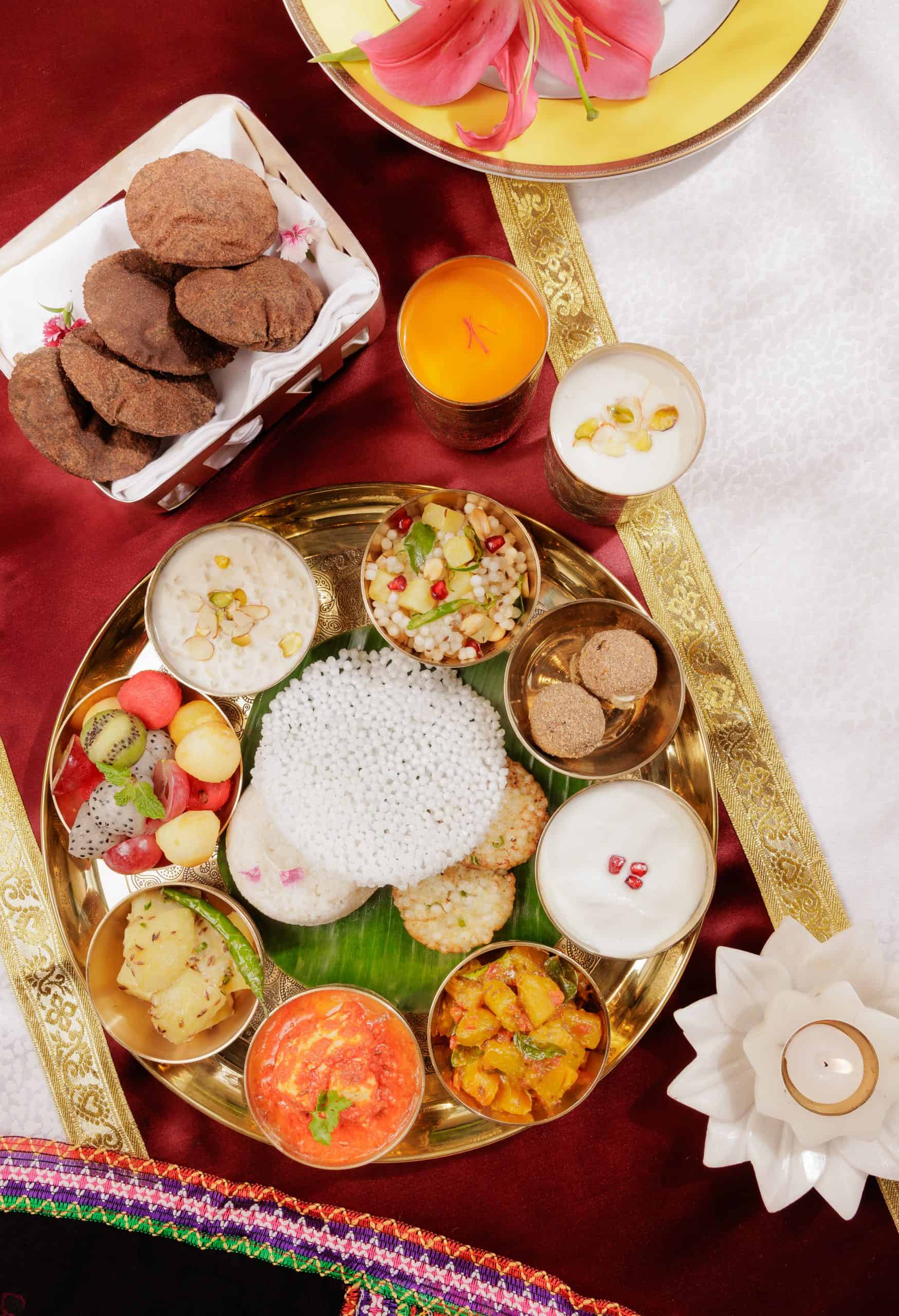
Satvik temple-style thalis are the quietest in this collection, and perhaps the most profound. They do not seduce with excess. They calm the table down. Rooted in ideas of purity, seasonality, balance and devotion, the satvik thali avoids onion, garlic and often root vegetables, depending on the tradition being followed. The flavours are gentle, but never dull when cooked with care.
A satvik platter may include steamed rice, millet khichdi, moong dal, lightly spiced gourds, pumpkin, raw banana, greens, moringa leaves, coconut chutney, curd, rock salt, cumin-tempered vegetables, simple kadhi, payasam, fruit or a small sweet. The seasoning is measured. Cumin, coriander, ginger, curry leaves, pepper, tulsi, coconut and ghee are used not to dominate, but to bring clarity. The meal feels clean, luminous and deeply nourishing.
In temple towns such as Tirupati, Puri, Nathdwara, Udupi and many pilgrimage centres across India, food carries the aura of offering. The kitchen is not simply producing lunch. It is preparing prasad, community nourishment and spiritual hospitality. That changes the way the meal is received. A ladle of dal, a spoon of rice, a sabzi cooked without showmanship: each can feel unexpectedly complete.
Luxury here lies in restraint, intention and the rare pleasure of eating without heaviness. In a world of overdesigned dining, the satvik thali offers a different sophistication. It trusts ingredients. It respects rhythm. It allows the guest to leave satisfied rather than stunned. There is no need for smoke, foam or theatrical plating. The beauty is in balance.
Contemporary restaurants have begun presenting satvik cuisine with a more polished fine-dining sensibility. In cities such as Delhi, restaurants inspired by sattvik principles show how this food can move into elegant urban spaces without losing its calm essence. Brass lamps, clean plating, delicate sweets, seasonal vegetables and attentive service create a mood that feels serene but not austere. The satvik thali reminds us that luxury can be spiritual, not only sensory.
The New Luxury of the Vegetarian Thali
The vegetarian thali is having a very stylish moment because it offers what contemporary luxury increasingly seeks: authenticity without stiffness, abundance without confusion, and a sense of place that feels immediate. It does not need to announce itself as immersive. It already is. One plate can hold desert craft, merchant memory, temple discipline, palace nostalgia, agricultural wisdom and family affection.
For travellers, the thali is one of the most rewarding ways to understand a destination. In Rajasthan, it tastes of arid landscapes and royal kitchens. In Gujarat, it captures trade, agriculture, sweetness and spice. In Marwari homes and heritage hotels, it reflects refinement shaped by mobility and memory. In temple towns, it becomes devotion. In modern city restaurants, it turns into spectacle, nostalgia or polished regional storytelling.
Perhaps that is the real power of the thali. It refuses to separate food from culture. It understands that how something is served matters as much as what is served. The refill, the sequence, the katori, the leaf, the ghee, the sweet, the pickle, the second helping, the host’s insistence: each detail belongs to the experience. A great vegetarian thali brings luxury and soul to the same plate, then adds a little more ghee for good measure.
Read more: Food Voyager